What is a bilingual school?
A bilingual school is an institution in which two languages play a meaningful role in school life and, depending on the model chosen, can both become languages of instruction.
This structure can take many different forms depending on the institution.
- In some schools, English is a subject taught for several hours a week.
- In other schools, certain subjects or certain class periods are taught in English; in such cases,the term “bilingual education” or “partial immersion” is typically used.
- Other models provide for a more balanced distribution between the two languages over the course of the week or the day. The structure may, for example, be based on assigning a specific language to each teacher, on separate class periods, or on an equal division of school time.
This approach is important because language learning also depends on how children use the language in their daily lives. They make progress when they use the language to understand, act, communicate, and learn in real-life situations.
At Esclaibes International Schools, we have chosen to provide a balanced immersion program in French and English.
Does a bilingual school really teach in both languages?
At Esclaibes International Schools, French and English play a significant role in the school day. Children are regularly exposed to both languages, both in their studies and in their interactions with adults and other students.
Yes. In a bilingual school, both languages are used for learning, communicating, and participating in classroom activities. They thus become languages that are actively used and learned on a daily basis.
What is the difference between English classes and bilingual education?
In a traditional English curriculum, the language is studied as a subject at specific times during the week.
In a bilingual education program, on the other hand, both languages become everyday tools. Children gradually use them to understand instructions, complete activities, interact with others, and gain new knowledge.
How are the two languages distributed at Esclaibes?
At Esclaibes International Schools, class time is divided equally: 50% in French and 50% in English.
This approach ensures that both languages play a meaningful role in the child’s week, both in learning and in everyday interactions.
The program is designed to allow children to grow up in a truly bilingual environment, where both French and English shape their learning and classroom life from the very first years of school.
Do you have to already speak English to enroll in a bilingual school?
No. At Esclaibes schools, children can be enrolled even if they don't speak English beforehand—or even French.
A lack of prior proficiency in French or English is therefore not a deal-breaker. The team takes into account the child’s age, academic background, and the languages to which he or she has already been exposed in order to prepare for his or her arrival in the classroom.
Small class sizes allow us to offer more personalized language support. When a child does not yet speak French, he or she can benefit from dedicated French as a Foreign Language (FLE) instruction. Individual or small-group sessions can also be arranged based on the child’s needs, particularly when he or she is just beginning to learn both of the school’s languages.
These activities complement the daily immersion experience. The goal is not to wait until the child has mastered the language before introducing academic content, but to gradually provide the child with the necessary tools to understand, participate, and find their place in the classroom.
At what age should a child start attending a bilingual school?
There is no single age at which it is absolutely necessary to begin a bilingual education. Early exposure to languages can make it easier for children to become familiar with them, but a child can also fully benefit from a bilingual environment even if they start school later.
Early childhood is a particularly favorable period forlanguage acquisition, especially because the brain is highly plastic at this stage and particularly receptive to sounds and linguistic patterns.
In preschool, children discover languages through very concrete and repetitive situations. In elementary school, they can also gradually develop their comprehension and expression skills while continuing their academic studies.
A child can therefore enroll in a bilingual school without having been exposed to French and English since early childhood. The consistency of exposure, the quality of interactions, and the support provided remain essential: learning a second language is still possible well beyond the early years.
What common misconceptions about bilingualism should we set aside?
There are still many misconceptions about bilingualism in children. However, research shows that exposure to two languages does not, in and of itself, cause confusion or language delays. Their development may differ from that of a monolingual child, but that does not mean it is any less favorable.
Does learning two languages at the same time cause confusion?
No. Young children are able to distinguish between the languages they are exposed to from a very early age. Research conducted by Laura-Ann Petitto and her colleagues, among others, shows that this ability to differentiate between two linguistic systems emerges even before children say their first words. (Source: Cambridge University Press)
The fact that a child sometimes mixes words or switches from one language to another does not mean that the child is confused. This type of alternation is a common behavior observed in bilingual children and evolves as they are exposed to different languages.
Does bilingualism cause a delay in language development?
Bilingualism is not considered a cause of language delay or disorder.The American Speech-Language-Hearing Association states that multilingualism does not cause language disorders and that it is not necessary to recommend monolingualism for a child with language difficulties.
In a bilingual child, language skills may be distributed differently between the two languages: certain words or structures may be mastered better in one language than in the other. This can give the impression of differing development when observing only one language, without necessarily indicating an overall delay. (Source: Exploring Assumptions of the Bilingual Delay in Children With and Without Developmental Language Disorder)
Should we speak both languages at home?
No. Parents do not need to speak French and English at home for their child to develop proficiency in both languages at school.
It is even better for adults to speak to the child in the language or languages in which they are most comfortable, in order to provide the child with rich and natural interactions. During a roundtable discussion on the language of babies and children, Ghislaine Dehaene-Lambertz, a pediatrician and neuroscientist and director of cognition and education research at the Robert Debré Institute for the Child’s Brain, explained that “parents should speak the language they are most comfortable with.”
For its part, the bilingual school provides regular, structured exposure to the other language through teachers, activities, and everyday classroom life.
Do you have to start when you're very young to become bilingual?
No. Early childhood is a particularly favorable time for language learning, but that doesn't mean it becomes impossible to learn a second language later on.
The age at which a child begins to learn has a significant impact on how the child learns, but regular exposure, meaningful interactions, and a supportive learning environment remain crucial at any age.
How can you tell if a bilingual school is high-quality?
The term “bilingual” can mean very different things from one school to another. To understand what a school’s language program actually entails, it’s helpful to look beyond the number of English class hours listed on the schedule.
A high-quality bilingual school must be able to clearly explain:
- the role played by each language;
- how they are used in learning;
- how children are supported when they have not yet mastered one of these skills.
How Does Bilingual Education Work at Esclaibes International Schools?
At Esclaibes International Schools, bilingualism is based both on a balanced use of the two languages and on a learning environment that allows children to maintain their sense of orientation as they switch between French and English.
A language immersion program that is 50% French and 50% English
School time is divided equally between French and English.
Depending on the school, this alternation can take different forms. In Clichy, children move from a French-speaking environment to an English-speaking one and switch classrooms throughout the week. In schools in Paris, as well as in Lyon and Marseille, the two languages are taught by French-speaking and English-speaking teachers within the classroom, depending on the established schedule.
In any case, the principle remains the same: to allow children to develop their skills in both languages on a regular basis, rather than limiting English to just a few specific times.
Learning in a language you haven't mastered yet
When a child does not yet understand the language being used, he or she can rely on familiar cues: the adult’s gestures, demonstrations, routines, as well as the materials and activities provided.
In Esclaibes classrooms, children encounter consistent materials and learning pathways across languages. Montessori materials, in particular, serve as a common point of reference: children can recognize an activity and draw on what they have already learned, even when the language used changes.
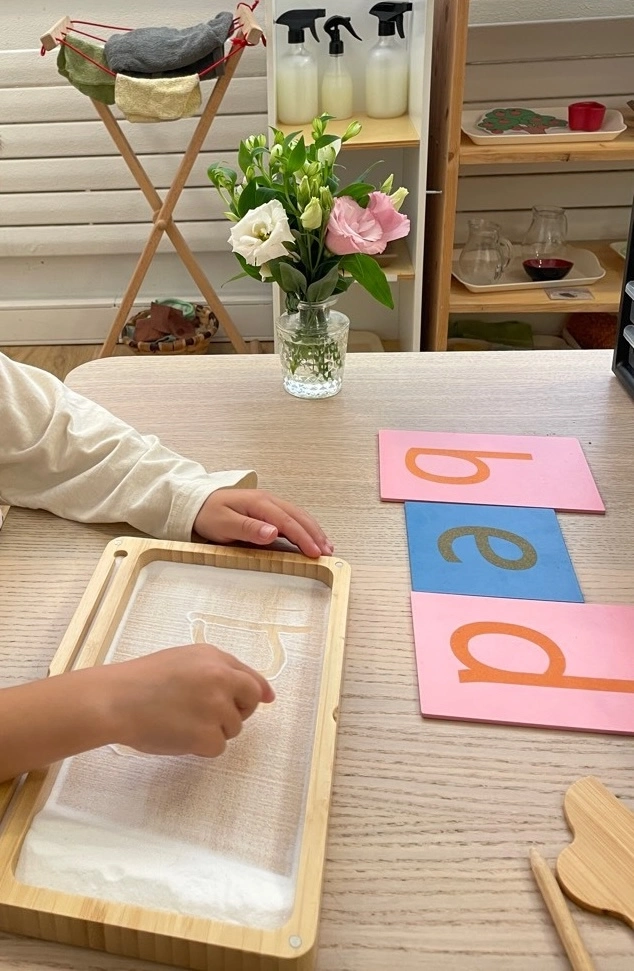
This is particularly evident inthe process of learning to read. In both French and English, children follow the same Montessori progression: sensory and phonological preparation, discovery of sounds, manipulation of letters, encoding, and then decoding. The materials and steps remain the same; it is the sounds and vocabulary specific to each language that differ.
When immersion alone is not yet sufficient, individualized instruction and support in French as a foreign language (FLE) help reinforce certain language skills without isolating the child from the rest of classroom life.
Thus, FLE becomes a complement to immersion, not a contradiction to it.
Children with very different linguistic backgrounds
Esclaibes schools welcome children with a variety of linguistic backgrounds: some speak mainly French, others English, and still others a third language at home.
Some children are introduced to English when they start school; others are non-French speakers; still others have already grown up in a multilingual environment. The support provided therefore takes into account each child’s starting point, without expecting them to fit a standardized linguistic profile.
This linguistic diversity is part of a broader international environment. Every day, children interact with classmates from many different countries, some of whom speak a language other than French or English at home. Bilingual education thus takes place in a context where linguistic and cultural diversity is an integral part of classroom life.
For families living abroad, choosing a school also raises specific questions: check out our tips for choosing a school as an expatriate.
Which Esclaibes bilingual school in Paris should you choose?
The Esclaibes schools in Paris and the surrounding suburbs all follow the same principle: a 50/50 French-English immersion program. The choice ultimately depends on the child’s age, the desired level of education, and the campus location.
Regardless of the school, a lack of prior proficiency in French or English is not a deal-breaker. However, the child’s academic history and application materials are reviewed as part of the admissions process. The differences between campuses mainly concern the age groups served, the continuity of the educational program, and the location.
Is it possible to enroll in a bilingual school during the school year?
Yes. Mid-year enrollment is possible at Esclaibes bilingual schools, subject to availability.
It is not necessary to have previously attended a bilingual program. The team is primarily interested in the child’s background and the conditions that will help prepare them for integration into the classroom.
This flexibility makes it possible, in particular, to accommodate children who are changing schools or families who are moving to Paris after the start of the school year.
How much does a bilingual school in Paris cost?
The cost of a bilingual school varies depending on the school, the child's grade level, the number of days attended, and the chosen schedule.
At Esclaibes International Schools, the current tuition rates in the Paris region range from approximately €8,600 to just over €20,000 per year, depending on the campus and the program chosen.
These amounts are based on the estimated rates for 2026–2027. Enrollment fees, administrative fees, meal costs, and certain additional activities may apply, depending on the school and the program selected.
To find out exactly what fees apply to your child, it’s best to check the website of the school in question and its detailed fee schedules.
What is the admissions process like for an Esclaibes bilingual school in Paris and other parts of France?
The admissions process begins with a discussion with the family to understand their goals, the child’s background, and how the child functions on a daily basis.
It is usually followed by:
- a tour of the facility;
- review of the student's academic record;
- a meeting with the family;
- and, depending on the level, a day of immersion or a trial session.
The review of the child’s file is not intended to select children based on their proficiency in French or English. These discussions are primarily designed to understand the child’s background, strengths, needs, and the conditions that will facilitate their transition. When language support is needed, the team can also plan for French as a Foreign Language (FLE) classes or individualized instruction that may be offered after the child’s arrival.
The goal is therefore both to prepare for the child’s arrival and to decide whether to admit the child. For older children, the immersion day then provides an opportunity to compare the information gathered during the interview with observations made in a real-life setting.
Learn more about Esclaibes Schools’ approach to bilingual education.