Where can I find a Montessori school in Esclaibes near me?
For the 2026–2027 school year, Esclaibes International Schools operates several Montessori schools in Paris, Clichy, Lyon, and Marseille. Depending on the school, children can enroll starting in early childhood and continue their education through elementary school or middle school. The grade levels offered, class structure, and certain program specifics vary by campus.
The schools share a common educational foundation based on the Montessori method, bilingualism, andindividualized support. They enable each child to progress at their own pace in acquiring the expected knowledge and skills, in line with the National Education curriculum. They foster the development of children’s independence and psychosocial skills.
The choice is based primarily on location, budget, and the family’s daily constraints. Continuity of the educational path through elementary school or middle school may then be an additional factor, but it is not necessarily a deciding factor.
A school that only serves children through preschool or the early elementary grades can still provide a particularly enriching educational experience for several years. Therefore, there is no need to rule out a school that is a good fit for your child simply because you will eventually need to consider the next stage of their education.
The network is also continuing to expand. Its range of schools and grade levels may therefore change over the next few years, particularly in the Paris region, where the group is exploring new opportunities to extend the continuity of the educational path through middle school and, eventually, high school. In Marseille as well, the middle school is expanding and will be able to accommodate more students.
Which Esclaibes Montessori school should you choose in Paris and the surrounding area?
Esclaibes International Schools has four campuses in Paris and the surrounding suburbs: Paris 8, Paris 15, Paris 16, and Clichy. The primary consideration is, of course, location, to ensure that the daily commute is compatible with family life. The child’s age, the grade levels offered, and certain characteristics specific to each campus then help identify the most suitable school.
The four schools share the same educational mission: to provide every child with a safe, stimulating, and challenging physical and social environment in which they can progress at their own pace and develop their knowledge, independence, and psychosocial skills.
The differences mainly relate to location, the age groups served, the programs offered, and the campus environment. Continuity through elementary school may be a plus for some families, while others will place greater importance on proximity, the availability of outdoor space, or a school dedicated entirely to young children.
Where can I find an Esclaibes Montessori school in Marseille?
Esclaibes International Schools has two campuses in Marseille, in the 7th and 12th arrondissements. Both offer an enriched Montessori curriculum and a bilingual French-English environment, with staff composed of French- and English-speaking professionals. Their locations allow families in Marseille to access this educational program in two different parts of the city.
What kind of education does the Marseille 7 school offer?
Scheduled to open at the start of the 2026 school year at 21 Boulevard Tellene in the 7th arrondissement, the school serves children ages 2 to 7, from preschool through CP-CE1.
The school is organized around two multi-age classes and a bilingual French-English environment. The intentionally small-scale format allows for attentive support for each child, in a setting designed for the early years of schooling.
The school also features a 300-square-meter outdoor courtyard, a significant asset in an urban setting. From the moment they enter the school, children interact with both French- and English-speaking adults and are thus exposed to both languages on a daily basis in real-life and learning situations.
Marseille 7 is therefore aimed at families in the area who are looking for a small, bilingual Montessori school with a natural outdoor environment and language immersion starting at a very young age.
Up to what age can children attend school in Marseille 12?
Located at 7 Rue Gaston de Flotte in the 12th arrondissement, the Marseille 12 school opened its doors in 2014. Today, it serves children from preschool through middle school.
This range of educational options is a real advantage: not all Montessori schools in Marseille offer education through high school. Families can therefore enroll their children at a very young age in a Montessori and bilingual environment, and then provide them with a continuous educational path through the end of Cycle 4.
The school combines an enriched Montessori curriculum, bilingual French-English instruction, and individualized learning support. The French- and English-speaking staff enable children to develop their skills in both languages on a daily basis, going beyond simple English classes.
Marseille 12 is also committed to implementing the IB Primary Years Program, which further strengthens the international and rigorous nature of its educational program.
In Marseille, the challenge is therefore not just to find a Montessori school close to home, but to choose a school that can offer a rigorous, bilingual, and sustainable educational environment tailored to the child’s age and the family’s goals.
Is there a Montessori Esclaibes school in Lyon?
Yes. Esclaibes International Schools is located in Lyon’s 6th arrondissement, at 8 Rue Barrier, and features a Montessori school that serves children ages 2 to 12, from the preschool program through elementary school.
Founded in 1982, the École Montessori de Lyon joined the Esclaibes network in 2026. It retains its traditional structure, organized around five Montessori environments:
- 1 preschool class for 2- to 3-year-olds;
- 2 daycare centers for children ages 3–6;
- 2 basic themes for children ages 6–12.
French-English bilingualism has been gradually introduced there since the start of the 2026 school year, with the addition of English-speaking members to the teaching staff.
The school is distinguished by more than forty years of Montessori tradition, a comprehensive program for children ages 2 to 12, and the development of a bilingual environment within a school that is already firmly established in Lyon.
How do I choose a Montessori school that's right for my child?
You shouldn't choose a Montessori school just because it's close to home or because it uses Montessori materials. It's helpful to consider:
- team training;
- class organization;
- monitoring learning;
- ages served;
- the proposed framework;
- how the educational program is actually implemented on a day-to-day basis.
What should you look for when choosing a Montessori school?
- The Montessori approach is based first and foremost on a prepared environment, designed to enable children to act with increasing independence. The furniture, materials, and layout of the space must be age-appropriate and allow children to choose an activity they can handle, carry it out, and then put away what they have used.
- The Montessori materials also plays an important role. It’s not just about providing beautiful wooden objects: each material serves a specific purpose and is part of a progressive learning path. Children can handle the materials, experiment, repeat an activity, and gradually move toward more abstract concepts.
- Organizing students into mixed-age groups is another key feature of this educational approach. It allows younger students to observe older ones, enables more advanced students to reinforce certain skills by helping others, and lets each student progress at their own pace without the entire class following exactly the same progression at the same time.
- Finally, the role of the adult is crucial. The educator observes, introduces activities, supports the child, and ensures that the guidelines are followed. A visit therefore provides an opportunity to observe not only the materials available in the classroom, but also how the children use them and how the adults intervene.
At Esclaibes International Schools, this Montessori foundation is enriched by other aspects of the educational program:
- immersive French-English bilingual education: 50% of the time in each language;
- Through creativity, children are encouraged to ask questions, formulate hypotheses, propose ideas, and present arguments. Their input is listened to and can contribute to classroom projects, presentations, and research;
- hands-on and active learning: children manipulate, experiment, explore, and participate in projects, within a Montessori approach that is open to other active teaching methods, such as project-based learning;
- a personalized support, made possible in particular by smaller class sizes.
What questions should you ask when visiting a Montessori school?
Visiting a Montessori school allows you to go beyond simply hearing about the educational philosophy and to understand how it plays out in the child’s daily life.
Here are a few questions that can help you compare schools:
These questions allow you to compare very specific aspects: beyond the “Montessori” label, they provide insight into how the school actually operates, the support it offers, and how the school meets the needs of the child and his or her family.
In a Montessori school, do children really do whatever they want?
No. In a Montessori classroom, children have some freedom of choice, but this freedom is exercised within a prepared environment, with rules, boundaries, and activities presented by the adult. The goal is not to let them do whatever they want, but to help them gradually become independent while respecting the group’s framework.
What happens when a child doesn't want to do their work?
Montessori autonomy does not mean that a child can avoid certain learning experiences indefinitely. The educator observes the child’s choices, interests, challenges, and level of development in order to offer appropriate activities and support the child’s progress.
When a child does not spontaneously engage in an activity or loses interest in a particular area, an adult can:
- show him some new equipment;
- resume a presentation;
- change the way they provide support;
- try to understand what is holding back their commitment.
The prepared environment also makes it possible to offer several different approaches to developing the same skill.
But engagement cannot be forced. Some children need to observe for a long time before they dare to try, before they understand what is expected of them, or before they feel secure enough to begin learning. Adults should not force the issue: they should listen, rephrase, encourage, and set boundaries, all while respecting the child’s pace.
At Esclaibes International Schools, this relationship is based on trust, kindness, and respect. The goal is to create an environment in which children feel secure enough to ask questions, try new things, make mistakes, and try again. The role of adults therefore remains essential: they observe, guide, encourage, and step in when necessary, without, however, allowing children to choose their entire academic path on their own.
This approach to establishing boundaries without entering into a power struggle is, more broadly, consistent with the approach outlined in our article on educational authority.
How do we know if a child is making progress?
In a Montessori classroom, progress is not based solely on identical exercises completed by the entire class at the same time. The teacher monitors each child over time, observing the activities the child has mastered, those the child is discovering, and the skills the child still needs to strengthen.
This monitoring allows us to tailor the activities and suggestions presented to the child, while maintaining a comprehensive view of the child’s learning progress.
At Esclaibes International Schools, this support takes different forms depending on the students’ age.
- In preschool, teachers observe the children on a daily basis and gradually document the skills they acquire, ranging from independent daily living skills to early academic learning. For example, they may track everything from a child’s ability to put on a coat by themselves to progress in language, math, or the early stages of reading and writing.
- In elementary school, progress tracking relies in particular on a school work plan and in-house French and math workbooks. These tools enable students to progress gradually in their learning while providing teachers with a clear overview of the concepts being covered, those already mastered, and those that need further reinforcement. The materials used are designed in accordance with the National Education curriculum.
As children grow older, more traditional assessment methods are also introduced, particularly in elementary and middle school. Progress reports are issued twice a year, and families can meet with teachers whenever they feel the need or when the teaching staff believes there is something worth discussing.
Assessment is therefore not absent: it takes several forms and serves primarily to understand where the child stands, adjust the support provided, and make the child’s progress clear to the child, the teachers, and the family.
To learn more, check out“ ” which covers individualized support in schools and the most common misconceptions about Montessori education.
Do children always work on their own in Montessori?
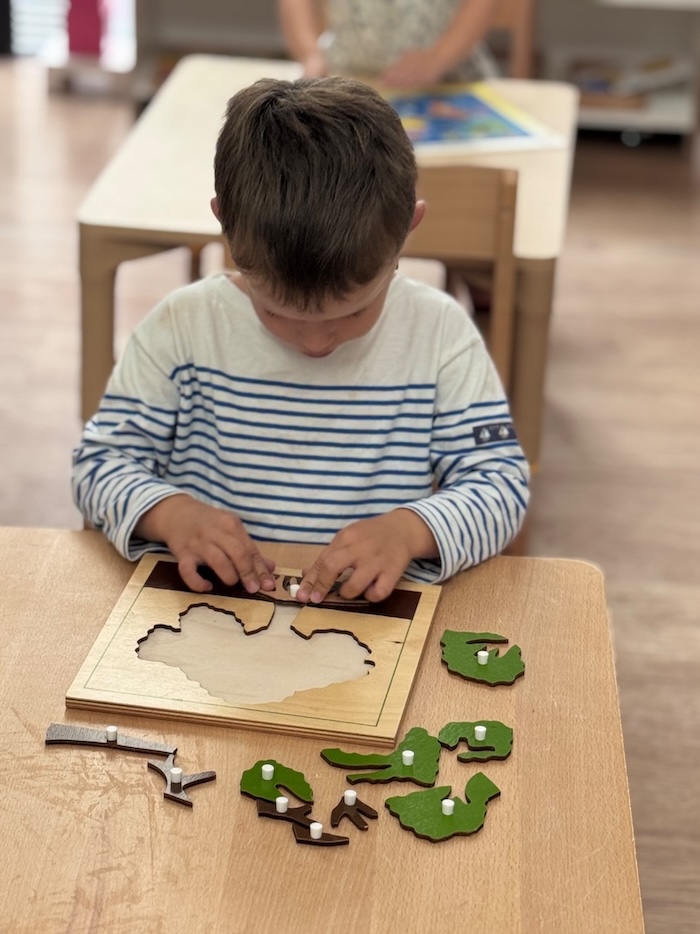
No. Independence and individual work play an important role in the Montessori approach, but they do not mean isolation or a lack of group activities. Classroom life, interactions among children of different ages, projects, mutual support, and shared activities also contribute to a child’s social and relational development.
Why are some activities done individually?
Some Montessori activities are designed to be done independently so that the child can:
- to concentrate;
- repeat a movement or exercise as many times as necessary;
- move forward at one's own pace.
This individual time helps foster concentration and independence, among other things. It also allows the child to resume an activity without having to follow the group’s pace or wait for the entire class to be ready to work on the same concept.
However, this does not mean that every child is constantly working on their own. Depending on the activities, their age, and what they are learning, children may observe a classmate, help one another, work in groups, or participate in group activities.
How do we develop cooperation and social skills?
Life in a Montessori classroom offers many opportunitiesto learn how to get along with others. Mixed-age groups encourage interaction among children, observation, mutual support, and the sharing of knowledge. Younger children can look to older ones for inspiration, while the older children also learn to explain, help, or guide others.
At Esclaibes International Schools, the development of social skills also involves numerous group projects, carried out in the classroom, school-wide, or with external partners.
In elementary school—and sometimes in middle school—students go on field trips, either every year or every two years, depending on the school. These experiences provide a different way to learn about cooperation, independence, taking on responsibilities, and group dynamics.
Several schools in the network are also participating in an Eco-School certification. Students, teaching staff, and families work together on projects related to the chosen theme: creating a collaborative cookbook focused on food, studying soil and planting vegetation in the schoolyard to explore biodiversity, or intergenerational projects centered on citizenship and climate issues.

In middle school, this project-based approach also takes on more ambitious forms. In 2026–2027, the students will develop an entrepreneurial project for a citizen-run newspaper: defining the concept; seeking funding and partners; and carrying out the project.
Cooperation also develops in more everyday situations: preparing a recipe together for a birthday, organizing a picnic, giving presentations, presenting a topic to the group, listening to others’ questions, or welcoming parents who come to share a tradition, a language, or an aspect of their culture of origin.
This encourages children to listen, explain, present arguments, ask questions, support a classmate, offer encouragement, and take others' perspectives into account.
Community service projects also contribute to this learning process. For example, students made and sold bookmarks to benefit a project supported by the organization Les Enfants du Mékong, taking an active role in both the organization and the sales.
The autonomy sought by the Montessori method is therefore not autonomy “against” the group: it is built within a community in which the child gradually learns to find his or her place, to cooperate, and to contribute to shared projects.
Up to what age can a child attend a Montessori school?
The Montessori approach does not end in preschool. It can continue through elementary school and, depending on the school, into middle school. In practice, therefore, it depends less on the approach itself than on the grade levels actually offered by the chosen school and the continuity of the educational path it is able to provide.
Can you continue with the Montessori method after preschool?
Yes. After the early years, the Montessori approach continues to adapt to the child’s developmental needs: more group work, projects, research, abstract thinking, and exposure to the world.
The program therefore evolves as children grow older. Children do not remain in a program designed for 3- to 6-year-olds: the materials, the activities offered, the role of the group, and the educational expectations all evolve along with them.
For families, the main consideration is to determine up to what grade level the school accepts students. Some Montessori schools only go up to kindergarten, while others also offer elementary school—and even middle school.
Can students continue their education at Esclaibes through elementary school and then middle school?
Yes. Several Esclaibes schools now offer education beyond preschool, through elementary school and, in Marseille 12, through middle school.
This program covers the 2026–2027 school year and is intended to evolve as the network expands. Esclaibes International Schools is continuing to expand its offerings at the secondary level, notably by expanding the middle school in Marseille and seeking a campus in Paris that will eventually allow the school to accommodate more students in middle school and even high school.
Continuity in a child’s educational journey can be an asset for families who wish to avoid changing schools, but it should not be the sole criterion for choosing a school. A few years of schooling in a bilingual, individualized Montessori environment can already provide a child with significant benefits, even if a new phase of their education must later be pursued at another school.
Can a child who has attended a Montessori school later enroll in a traditional school?
Yes. A child attending a Montessori school can later transfer to a public school or a private school under contract. At Esclaibes International Schools:
- Learning is monitored over time;
- the National Education curriculum is taken into account;
- Each student has a school record that facilitates their transition to another school.
How is student learning monitored and assessed?
In a Montessori school, monitoring a child’s progress does not necessarily rely on the same assessment methods as in a traditional school. Through regular observation, the activities completed, the skills mastered, and those that still need to be strengthened, the teaching team is able to track the child’s progress over time.
At Esclaibes International Schools, this monitoring process relies on several tools and opportunities for discussion.
- In preschool, teachers document the skills children have acquired throughout the year and track each child’s progress in the various areas of learning.
- In elementary school, students work primarily with work plans and French and math workbooks developed in-house, in accordance with the National Education curriculum.
Progress reports are held twice a year, and additional meetings may be scheduled at the request of families or teachers when necessary. As the children grow older, more traditional assessment methods are also introduced.
Each student thus has an academic record that makes it easy to track their achievements and academic progress in the event of a school transfer.
What happens if you change schools?
When a child leaves an Esclaibes school, his or her academic records allow him or her to continue his or her education at another school, whether public or private under contract.
Change may naturally require a period of adjustment: the daily schedule, the pace of class, assessment methods, and even the role of group work may differ. However, the children arrive with a consistent learning history, identified skills, and a file that allows the receiving school to understand their educational background.
The experience gained in a Montessori school can also provide support during this transition. Throughout their schooling, children learn:
- to gain more independence;
- to take the initiative;
- to ask for help when they need it;
- to express their views and to actively engage in their learning.
These skills can help them find their bearings in a new school environment, even when it operates differently.
"You can tell Montessori kids by the fact that they're not afraid of anything!"
Camille, a former student at the École Montessori de Lyon, says that the support she received during her time at the school helped her develop confidence in herself, her ideas, and her projects. She also emphasizes how much this confidence still helps her today to speak up, express her point of view, and feel confident in the situations she encounters.
This is particularly true at the end of CM2. Each year, students from Clichy, Paris’s 15th arrondissement, Lyon, or Marseille enroll in public or private middle schools when continuing their education within the public school system is not possible or does not align with their families’ preferences. To date, Esclaibes International Schools is not aware of any admission difficulties related to the fact that these students attended a non-contract Montessori school.
Families who have moved here from abroad also report that their children quickly settled into school while making progress in learning French.
This continuity is further facilitated by the fact that the curriculum is designed in accordance with the National Education System’s standards and that students’ learning progress is tracked throughout their schooling.
Is it possible to enroll in a Montessori school midway through a cycle or during the school year?
Yes. It is not necessary to have started your education in a Montessori program in early childhood to enroll in an Esclaibes Montessori school. Admission may be considered during the school year, as well as at any time during the year, provided there are openings.
The team focuses primarily on the child’s background, age, functioning, skills, and the conditions that will help prepare the child for integration into the classroom.
A child coming from a public school, a private school under contract with the government, or another Montessori school can therefore join a school in the network without having followed exactly the same progression previously. Individualized support allows teachers to assess the child’s current level, identify the skills the child has already acquired and those that need to be reinforced, and then gradually provide the child with appropriate activities and tools.
For older children, reviewing their school records and—depending on the school and grade level—a one-day immersion program can help the staff better understand their background and prepare for their arrival.
This flexibility is particularly important for families who are moving, returning from a stint abroad, or wishing to change their child’s school environment partway through the school year.
Not yet speaking French or English is also not necessarily an obstacle to admission to an Esclaibes school. Children can be gradually supported in both languages, particularly through immersion, small class sizes, and, when necessary, French as a Foreign Language (FLE) classes. We discussed this language support in our article on how a bilingual school in Paris operates.
How much does the Esclaibes Montessori School cost, and what do the tuition fees cover?
Esclaibes schools are private, non-contract schools. Their tuition fees therefore directly fund a large portion of their operations: teaching staff, facilities, equipment, professional development, guest speakers, and services offered to families. Tuition rates vary by school and grade level.
Education is never free. In France, average education spending in 2025 was €9,440 per elementary school student and €11,780 per secondary school student, with these amounts largely funded by the government (DEPP memo dated September 29, 2026). In a private school not under contract with the government, the state does not cover teachers’ salaries.
Tuition fees are used, among other things, to fund:
- the salaries of the teaching staff and other professionals at the school;
- the facilities, their maintenance, and their equipment;
- educational materials, including Montessori materials;
- initial and ongoing training for teams;
- educational presenters and projects;
- Services offered to families, depending on the institution.
At Esclaibes International Schools, tuition varies depending on the school, the child’s age, the number of days attended, and, at some campuses, the dismissal time. Meals, after-school care, summer camps, and certain activities may be subject to additional charges.
Lyon Tuition Rates for the School Year 2027–2028. The other amounts correspond to the fee schedules currently provided by the schools and should be verified at the time of registration.
To learn more about what factors influence the cost of a private Montessori school, you can also check out our guide to Montessori school tuition.
Are the Esclaibes schools AMI-accredited Montessori schools?
No. Esclaibes schools draw heavily on Montessori pedagogy and materials, but the network does not currently claim general affiliation with the Association Montessori Internationale (AMI). This choice reflects an educational approach that preserves the fundamentals of the Montessori method while combining them with other active learning methods, bilingual education, and creativity.
Some schools in the network may have been affiliated with or recognized by AMI before joining Esclaibes International Schools. However, the network has chosen to develop an enriched Montessori approach rather than seek to systematically maintain that affiliation.
In particular, this approach retains key elements of the Montessori method:
- the prepared environment;
- Montessori materials;
- multi-age classes;
- observation of the child;
- the development of independence;
- the opportunity to progress at an individualized pace.
It also embraces other teaching methods when they enhance learning: project-based learning, the Reggio Emilia approach, the Freinet method, and work focused on psychosocial skills.
The educational program also draws on findings from contemporary research on brain function and the mechanisms of learning. Brain plasticity, the role of attention, active engagement, feedback on mistakes, and the consolidation of learning are among the key concepts that inform the thinking of the teaching teams.
These principles are consistent, in particular, with Stanislas Dehaene’s work on the four pillars of learning: attention, active engagement, feedback, and consolidation.
French-English bilingualism is also a fundamental aspect of the Esclaibes project. The network’s educational approach, therefore, focuses less on replicating a single model and more on creating a coherent environment based on several complementary approaches.
The Esclaibes schools thus advocate an educational approach that is deeply inspired by Montessori but open-minded: it retains the fundamentals of the Montessori method while integrating them with other active teaching approaches, bilingualism, and current knowledge about the mechanisms of learning.
At the same time, some schools in the network are currently developing another international framework. The schools at Paris 8 and Marseille 12 are in the process of implementing the International Baccalaureate (IB) Primary Years Program.
How does the admissions process work at an Esclaibes school?
Admission to an Esclaibes school begins with a discussion with the family to understand their goals, the child’s background, how the child functions on a daily basis, and the conditions necessary to ensure the child is welcomed in the best possible environment.
It generally takes place in several stages:
Admission is based on mutual agreement. The goal is not merely to verify that a spot is available, but to ensure that the environment offered will truly be a good fit for the child. Following these discussions, both the family and the educational team may conclude that another school would better meet the child’s needs.
Admission may also be considered during the school year, subject to availability. It is not necessary to have previously attended a Montessori school or a bilingual program: the staff takes the child’s background into account and prepares for their integration based on their current level.
Find my school and request a tour
Contact the facility nearest you to find out which grade levels are accepted, check availability, and schedule a visit.